
Oil Tank Regulations UK
Last updated 30 October 2026 by Fuel Tank Solutions, OFTEC registered oil tank installers (OFTEC no. C101606).
The Short Answer
In England, a domestic oil tank must be at least 1.8 m from non-fire-rated buildings, eaves, doors, windows and flues, and at least 760 mm from a non-fire-rated boundary. It must stand on a level, non-combustible base that extends 300 mm beyond the tank on every side. It must be bunded if it holds over 2,500 litres, sits near water or drains, or supplies more than one home. The tank should be made to OFTEC standard OFS T100 (plastic) or OFS T200 (steel) and installed by an OFTEC registered technician.
Oil Tank Standards
Modern fuel storage tanks come in all shapes and sizes and can be made from plastic or steel to suit your requirements. The tank should be manufactured to OFTEC standards: OFS T100 for plastic tanks or OFS T200 for steel tanks. Installation work is covered by the Building Regulations (Approved Document J in England). An OFTEC registered technician can self-certify that the installation complies, so you don’t need a separate building control application.
Oil Tank Distance from a House and Boundary
There are specific rules on where a tank can go. Take them into account if you make later changes to your property, such as an extension, a new window or a shed. The rules are there for fire safety: a fire is highly unlikely to start in a fuel tank, but the stored fuel must be protected from fires and heat sources nearby. To protect the tank from an ignition source, it should be sited at least these distances away:
| Feature | Minimum distance | Notes |
|---|---|---|
| Non-fire-rated eaves of a building | 1.8 m | Measured from the closest part of the tank |
| Non-fire-rated building or structure (e.g. a garden shed) | 1.8 m | Timber and other combustible buildings |
| Openings in a fire-rated building (doors, windows) | 1.8 m | Applies to brick-built houses and garages |
| Oil-fired appliance flue terminals | 1.8 m | Includes the boiler flue |
| Non-fire-rated boundary (e.g. a wooden fence) | 760 mm | Boundary with a neighbouring property |
| Screening that isn’t part of the boundary (trellis, foliage) | 600 mm | Keep plants trimmed back |
What If You Can’t Meet the Distances?
If these distances can’t be met, you need a fire protection barrier with a fire rating of at least 30 minutes. The gap between the tank and the barrier should be at least 300 mm, unless the tank manufacturer specifies more. The other option is a fire protected oil tank, which is designed to sit closer to buildings and boundaries.
A fuel tank can be sited inside a garage or outbuilding, but it must be enclosed within a 60-minute fire-rated chamber.
Oil Tank Base Regulations
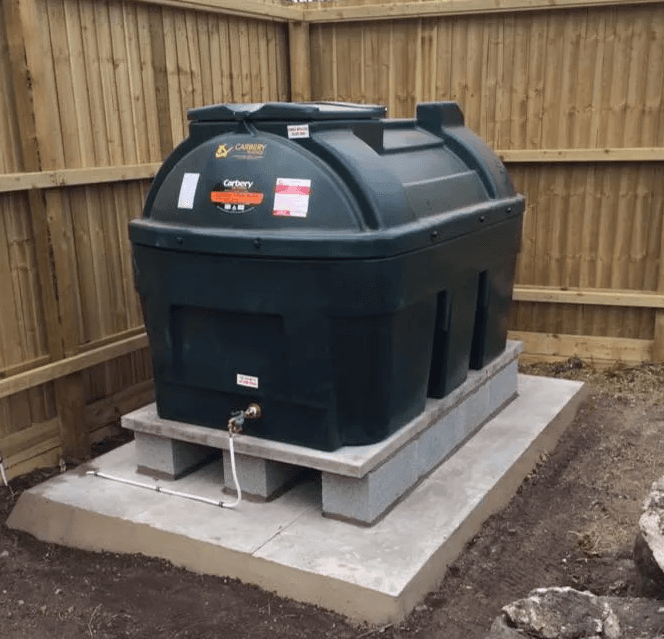
A tank that isn’t properly supported can become unsafe, fail early and spill fuel. The base must give continuous structural support, even as ground conditions change from season to season. The base should be:
- Strong enough for the weight of the tank and its contents (1,000 litres of fuel weighs just under a tonne)
- Non-combustible, imperforate and level
- Made of concrete, paving slabs or stonework
- Large enough to extend at least 300 mm beyond every side of the tank
As a guide, OFTEC suggests a concrete base at least 100 mm thick, or paving slabs at least 50 mm thick laid on a firm, compacted sub-base. We check the existing base on every replacement and lay a new one where it doesn’t meet these rules.
When Does an Oil Tank Need to Be Bunded?
A bunded tank has secondary containment, either built into the tank or around it, that holds at least 110% of the tank’s contents. In England, your OFTEC registered technician carries out a pollution risk assessment. A domestic tank normally needs to be bunded if:
- It holds more than 2,500 litres
- It is within 10 m of a river, stream, ditch, pond or other controlled water
- It is within 50 m of a borehole, well or spring
- Spilled oil could run into an open drain or a loose-fitting manhole cover
- It is on hard ground where spilled oil could reach controlled water
- It supplies a building other than a single-family home
- The vent pipe outlet can’t be seen from the fill point
Read our guide Do I need a bunded oil tank? for more detail. Businesses storing more than 200 litres of oil face stricter rules: see the government guidance linked below.
Scotland, Wales and Northern Ireland
The rules on this page apply to England. Scotland, Wales and Northern Ireland have their own building and pollution regulations, and some requirements, including when bunding is needed, are different. An OFTEC registered technician working in those nations will apply the local rules.
Inspecting and Replacing Your Tank
Fuel tanks have an expected working life of around 20 years, and the risk of a costly failure increases with age. Have your tank inspected every year as part of your heating system service, and your technician will tell you when it should be replaced.
Your fuel delivery driver may also spot problems with your tank. In extreme cases they can refuse to deliver if they are worried about the tank’s condition. It is common practice for drivers to put a warning notice on a tank as well as reporting any defects to you.
Looking after the tank on your property is your responsibility. Spills and leaks can be extremely costly to clean up and can contaminate groundwater or even building foundations. Check whether your home insurance covers oil spills and leaks, and whether the policy has any conditions or limits. OFTEC also recommends a visual check between services, especially after extreme weather, which puts tanks under extra stress. Look out for:
- Rust
- Splits or cracks
- Bulging
- Gauges falling over or not working
- Subsidence of the base
- A sudden increase in fuel use
- Tanks overgrown with foliage
- A strong fuel smell
Need a compliant new tank? See our oil tank installation service. We handle the risk assessment, siting, base and certification.
Oil Tank Regulations: Common Questions
How Far Does an Oil Tank Have to Be from a House?
At least 1.8 m from doors, windows and other openings in the house, 1.8 m from non-fire-rated eaves, and 1.8 m from the boiler flue. If you can’t achieve these distances, you need a fire protected tank or a fire barrier with at least a 30-minute fire rating.
How Far Does an Oil Tank Have to Be from a Boundary?
At least 760 mm from a non-fire-rated boundary, such as a wooden fence. Trellis or foliage that isn’t part of the boundary should be at least 600 mm away.
What Base Does an Oil Tank Need?
A level, non-combustible, imperforate base of concrete, paving slabs or stonework, strong enough for the full tank and extending at least 300 mm beyond the tank on every side.
Who Can Install an Oil Tank?
An OFTEC registered technician can install a tank and self-certify that it complies with Building Regulations. Otherwise, you need to apply to your local authority building control.